Variational Quantum Eigensolver applications for computational chemistry
About
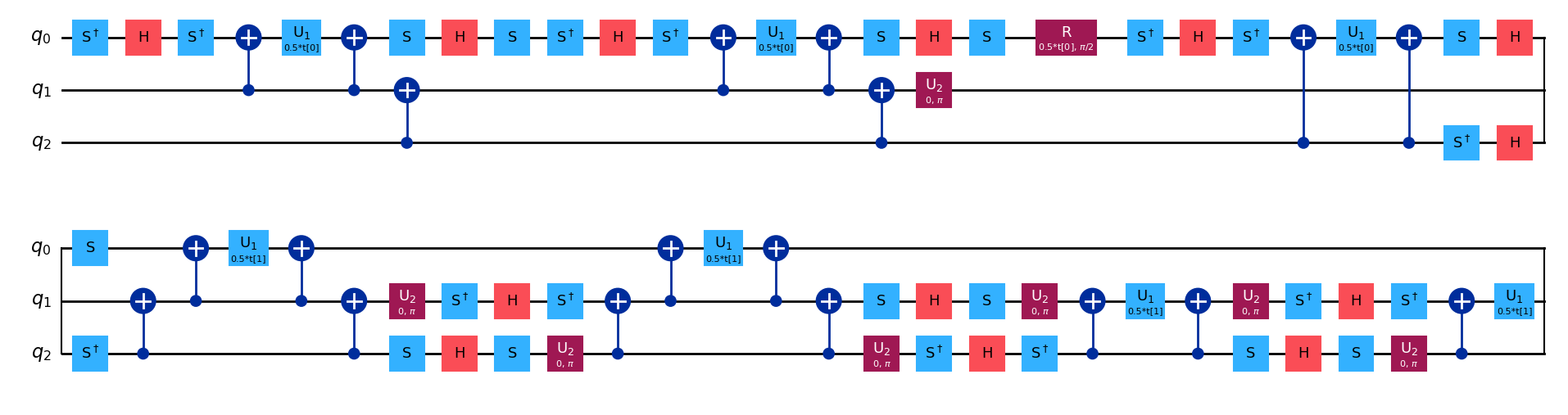
Electronic structure calculations are performed using the time-independent Schrödinger equation. Howeverm these calculations are computationally expensive and difficult to converge. This issue arises from attempts to recover the electronic correlation contributions.
The use of quantum computers is expected to improve the speed and quality of these calculations. By exploiting superposition, a quantum computer can explore multiple states at once, a property that scales exponentially with the number of qubits in the computer. Error reduction is also expected, as it reduces the approximations embedded in classical algorithms, and quantum algorithms are expected to naturally account for electron correlation.
The symmetry-adapted encoding methodology, developed by Picozzi and Tennyson, can be used to reduce the number of qubits required for a molecular system by 2–5, making it possible to compute molecular energies directly using small-sized quantum computers.
We have identified a small set of light molecules composed of combinations of H and He that can be tested using the VQE hybrid approach directly on the in-house Triangulum quantum computer and, later, on more advanced machinery. Calculations are in progress.
Team
- Marco Pezzella PostDoc — University of Perugia
- Marco Baioletti Associate Professor — University of Perugia