Triangulum — Quantum Computing Platform
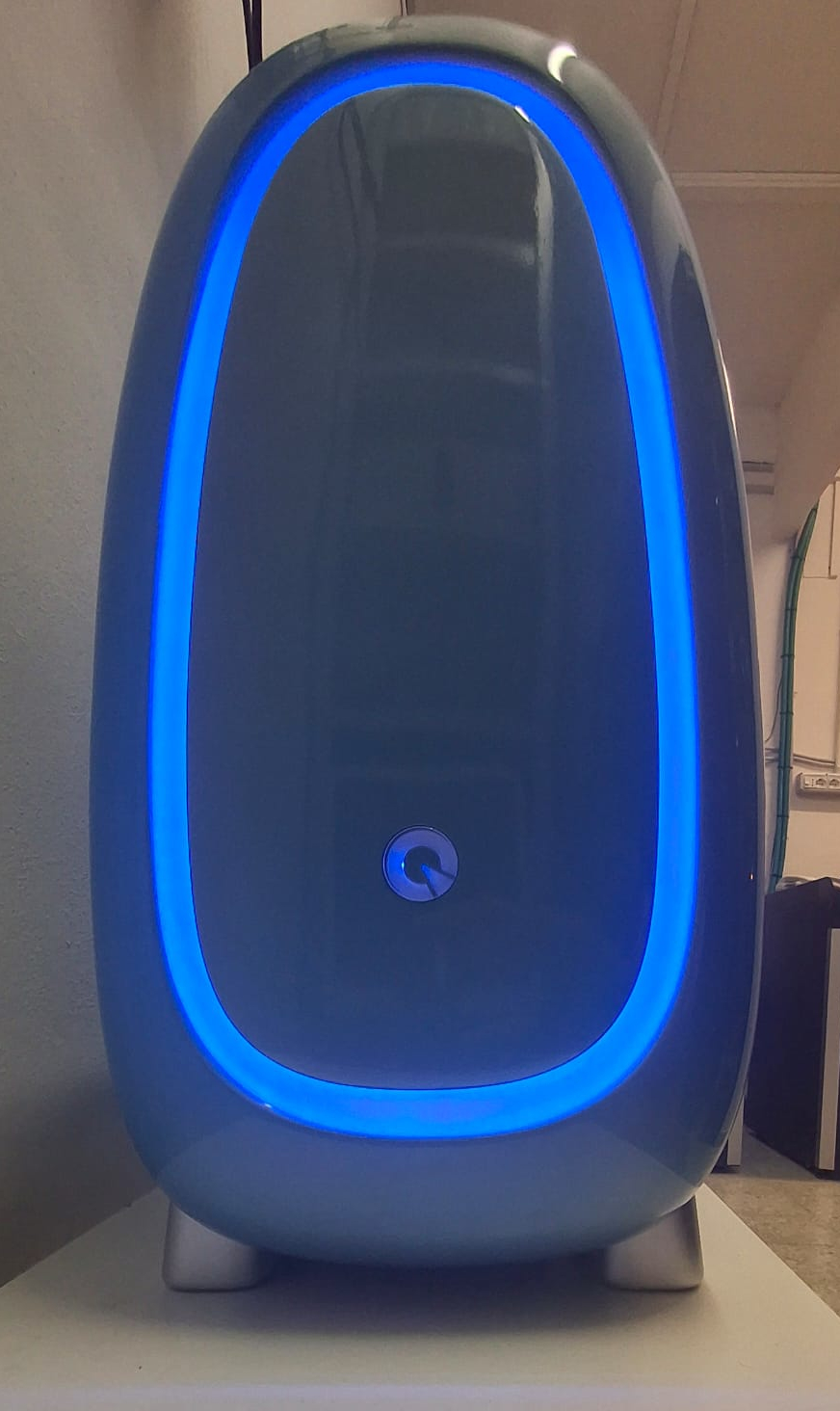
Triangulum is a quantum computer based on Nuclear Magnetic Resonance (Nuclear Magnetic Resonance Quantum Computer, NMRQC). In this architecture, the spin states of atomic nuclei within a molecule are used as qubits. The manipulation and readout of quantum states are performed using nuclear magnetic resonance techniques.
The probe molecule selected for this system is trifluoroiodoethylene (C₂F₃I), in which the three fluorine atoms act as qubits. Fluorine is particularly well suited for this purpose because it possesses a single stable isotope, 19F, characterized by a nuclear spin of 1/2. The coupling between the three fluorine nuclei is exploited to generate quantum entanglement among the qubits.
Unlike other quantum computing technologies, measurements in an NMRQC system are performed on a macroscopic ensemble of molecules (approximately 1015), rather than on individual quantum systems. This approach introduces several challenges, including nuclear decoherence and the need to operate with populations in mixed states close to thermal equilibrium. These effects are mitigated using small sized quantum computers (with maximum 20 qubits). Decoherence effects are further mitigated by keeping the sample temperature at 253 K.
The machine Link to heading
Reference publication Link to heading
The architecture, software interface, and applications for Triangulum are described in full in the manufacturer preprint:
G. Feng, S. Hao, et al. “SpinQ Triangulum: a commercial three-qubit desktop quantum computer” arXiv:2202.02983 [quant-ph], 2022.
Hardware description Link to heading
Triangulum is a liquid-state NMR quantum processor built around a 3-qubit homonuclear spin system. The processor exploits scalar J-couplings between nuclear spins to implement two-qubit gates. Single-qubit rotations are realised through shaped radiofrequency pulses generated by the spectrometer console. State tomography is performed via ensemble measurements of the bulk magnetisation.
| Parameter | Value |
|---|---|
| Technology | Liquid-state NMR |
| Qubit count | 3 (homonuclear 19F spins) |
| Coherence time T₂ | 0.2 s |
| Gate set | x, y, z, Rx, Ry, Rz, H, CNOT |
| Control | radio frequency control on the molecular J-coupling |
| Field strength | 1 T |
| Operating temperature | Room temperature |
Circuit diagram Link to heading
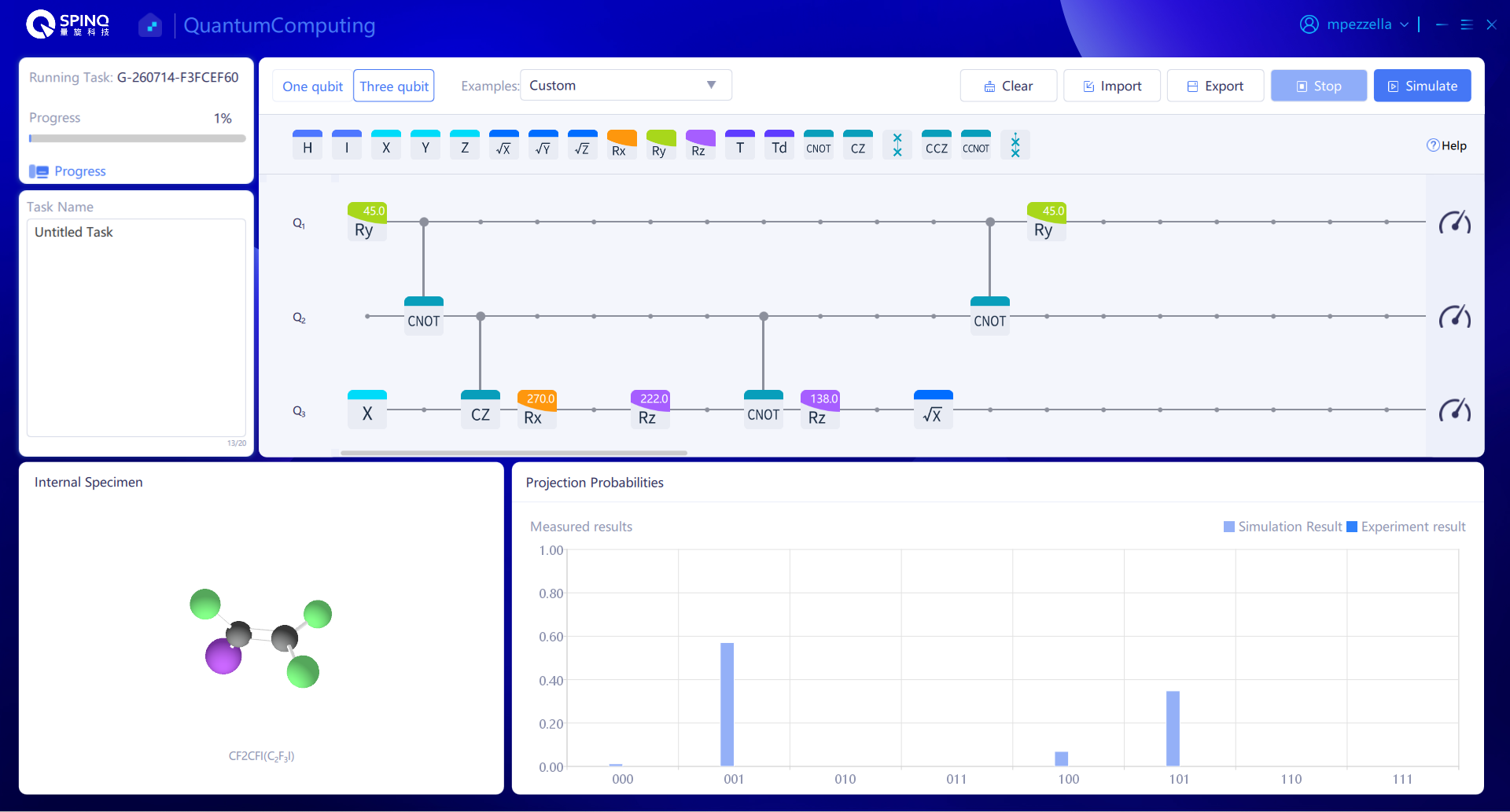
The figure below shows a representative quantum circuit executed on Triangulum for the implementation of the HHL algorithm. The HHL algorithm (Harrow-Hassidim-Lloyd) is used for solving systems of linear equations, as it is advantageous when the system is extremely large and when the matrix representing the system is sparse. One of its application fields is Quantum Machine Learning.
Integration with university infrastructure Link to heading
Triangulum is connected to the university’s shared research infrastructure through the UniNuvola prototype server.
Funding Link to heading
The acquisition and installation of Triangulum was funded by the Ricerca di Base di Ateneo 2022 grant awarded by the University of Perugia.