Quantum Machine Learning (QML) per l'analisi di dati in fisica delle alte energie (HEP)
Il progetto
Le attività di ricerca nel settore quantum computing riguardano principalmente lo sviluppo di algoritmi di Quantum Machine Learning (QML) per l’analisi di dati in fisica delle alte energie (HEP).
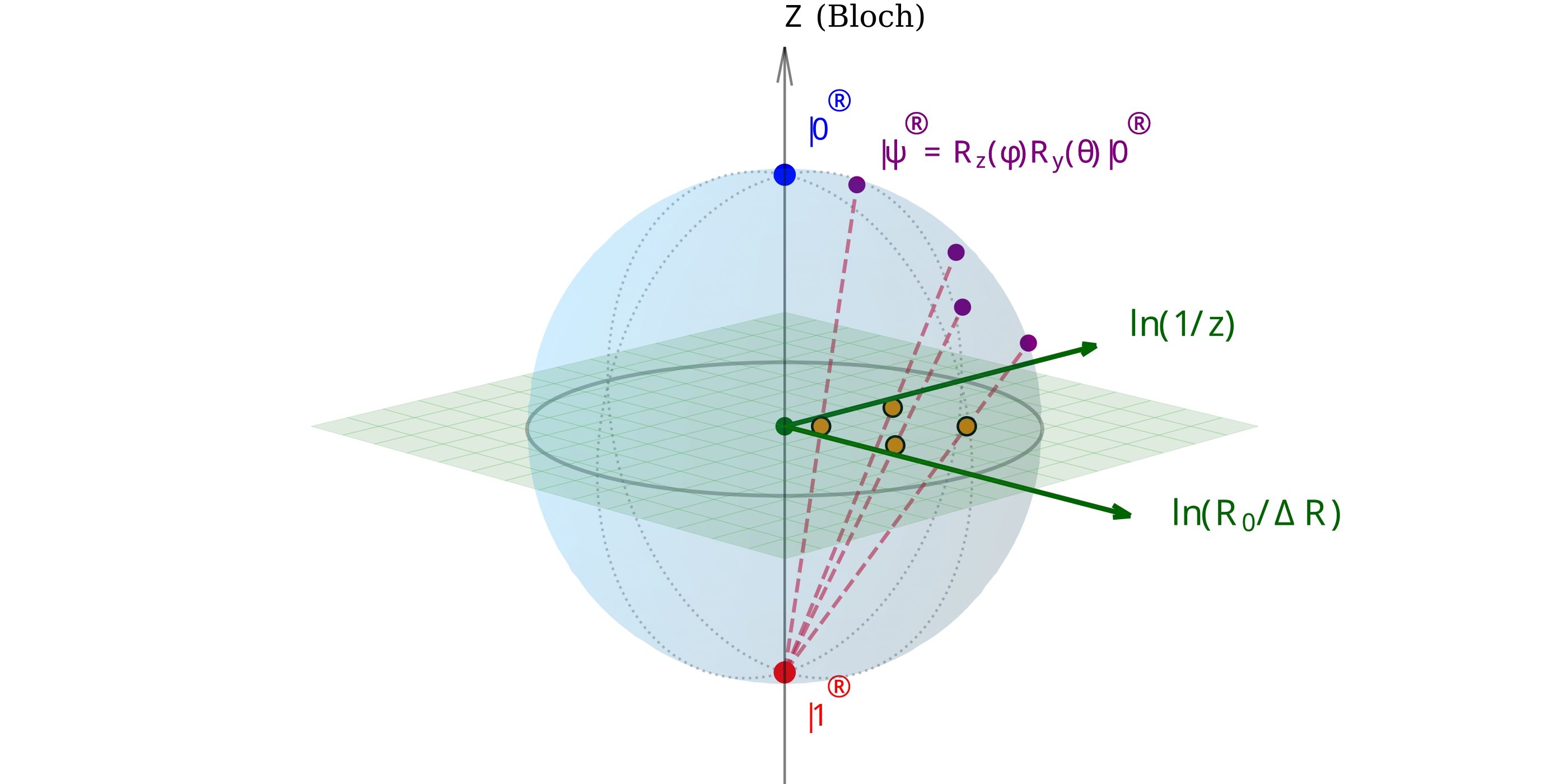
Il gruppo si occupa dello sviluppo di reti neurali quantistiche per l’analisi dei dati dell’LHC, con particolare focus su topologie boosted e processi di Vector Boson Scattering (VBS). In questo ambito abbiamo recentemente introdotto il metodo “Lund Plane to Bloch (LP2B) Encoding” per l’analisi della sottostruttura dei jet (preprint: arXiv:2604.18613, in corso di pubblicazione).
Il progetto QuEST (Quantum Experiment and Simulation Theory) è stato selezionato per il finanziamento dal Fondo di Ricerca di Ateneo 2025 dell’Università di Perugia. L’obiettivo è lo sviluppo di algoritmi di quantum machine learning e quantum simulation per la fisica delle alte energie.
Collaboratori
- Fabio Napolitano Ricercatore — Università degli Studi di Perugia
- Luca della Penna Dottorando — Università degli Studi di Perugia
- Tommaso Tedeschi PostDoc — INFN sezione di Perugia
- Livio Fanò Professore Ordinario — Università degli Studi di Perugia/INFN sezione di Perugia
Pubblicazioni
The application of quantum algorithms to jet substructure analysis is of growing interest as NISQ hardware continues to mature in qubit count and gate depth. Jet substructure remains essential for addressing demanding and complementary challenges at the LHC and beyond, notably object classification and polarization tagging. However, existing quantum machine learning approaches typically rely on data representations that suffer from infrared and collinear unsafety, sensitivity to non-perturbative effects, or poor scalability. In this work, we introduce the Lund Plane to Bloch (LP2B) encoding, designed to map a theoretically clean and robust representation of jet kinematics directly into qubit states. Leveraging this encoding, we implement a Quantum Tree-Topology Network (QTTN) that natively embeds the hierarchical structure of the Lund tree. We evaluate the QTTN across multiple benchmarks and observe that it matches the performance of large classical deep learning architectures, such as LundNet, on polarization tagging, while maintaining competitive accuracy for W boson and top quark tagging. The architecture demonstrates enhanced sensitivity compared to standard 1P1Q encodings on both polarization and W tagging, and pushes the Pareto front when compared against MLP of similar size and BDTs. Remarkably, the QTTN requires three orders of magnitude fewer parameters than LundNet, demonstrating promises for low-latency FPGA implementations in trigger systems. Furthermore, the QTTN outperforms classical methods in the low-data regime, making it suitable for low-yield, data-driven analyses. We also find that the quantum model is less susceptible to overfitting generator-specific parton shower and hadronization models than classical deep learning approaches, pointing toward potentially smaller systematic uncertainties. We validate the QTTN on real quantum hardware using a 3-qubit SpinQ device.